

There’s been a lot of discussion lately about the importance of “taste” in product management and design, especially as AI changes how quickly we can turn ideas into working solutions.
Some describe taste as the ability to recognize quality. Others associate it with aesthetics, intuition, or having a strong point of view about what makes a great product.
I think all of those can play a role. But I’ve been thinking about taste a little differently.
Taste is the ability to judge what is good enough to advance, given what we know, the risk involved, and the cost to recover if we’re wrong.
Experience, expertise, and intuition all contribute to that judgment. But knowing when to trust them, when to seek more evidence, and when to move forward matters just as much.
We rarely have complete information when developing products.
Good enough depends on the context
An aesthetically unrefined solution can solve a real customer problem. Sometimes getting something useful into people’s hands quickly is exactly the right decision.
But consider a brand known for exceptional design. Releasing something that falls significantly short of customer expectations might solve the functional problem while undermining the credibility and trust the company has spent years building.
And fixing the product doesn’t necessarily recover that lost trust.
The same applies beyond aesthetics. Decisions about privacy, reliability, accessibility, customer experience, and business models can have consequences that extend far beyond the immediate solution.
What qualifies as good enough depends on what we’re trying to accomplish, the expectations involved, and what happens if we get it wrong.
The confidence threshold isn’t a fixed line
Back in 2023, I developed a Balancing Risk and Confidence matrix as part of Whole Product Thinking.
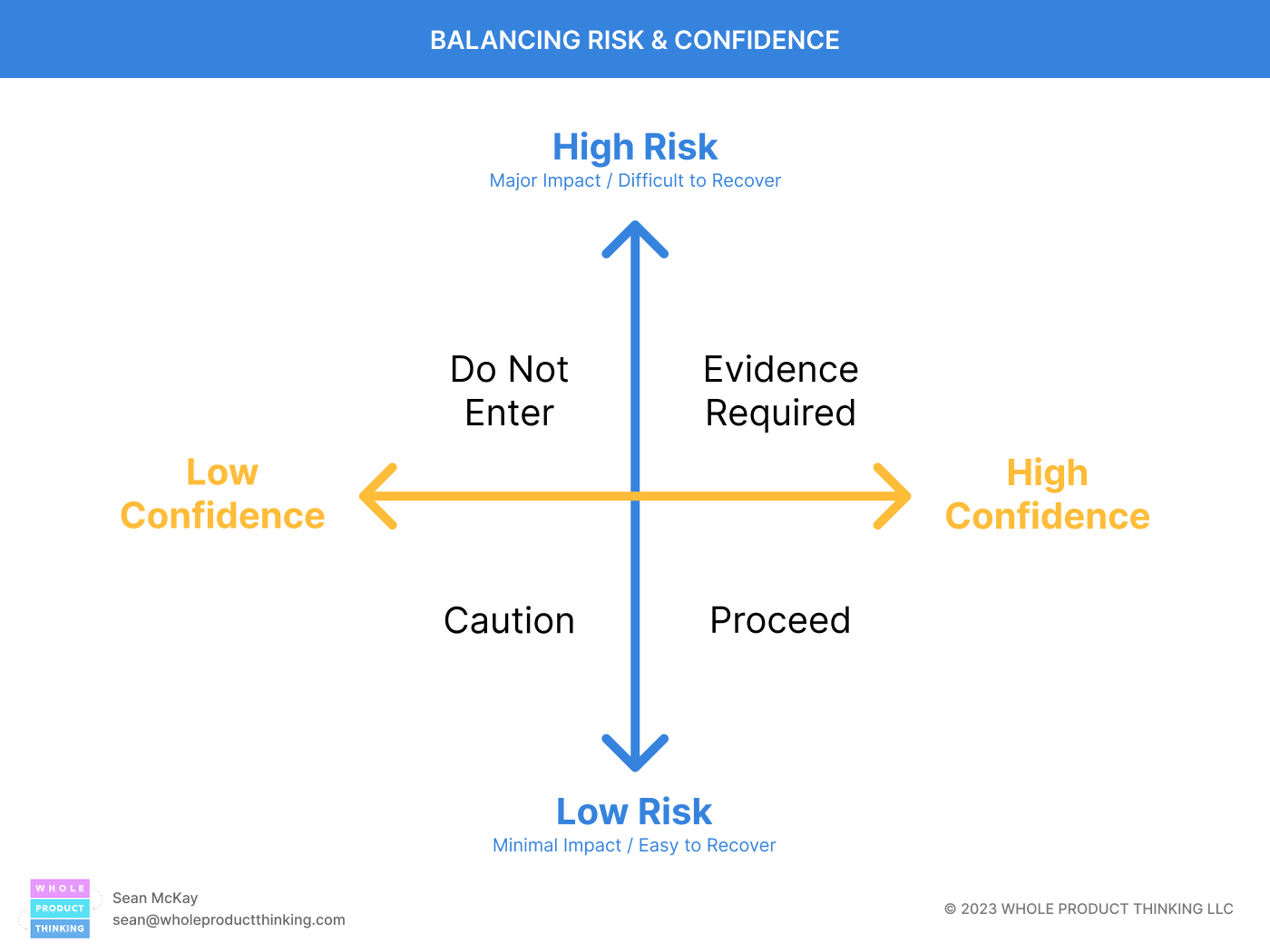
The idea was straightforward: The confidence threshold isn’t a fixed line. It moves with the risk involved and the cost of recovering if we’re wrong.
When confidence is low and the potential consequences are limited, moving quickly through experiments or prototypes may be the best way to learn.
When the potential consequences are significant or difficult to recover from, we may need stronger evidence and deeper understanding before advancing.
And even when confidence is high, we need to consider whether that confidence is justified by tangible evidence or based primarily on intuition, experience, or tribal knowledge. The higher the risk, the more important that distinction becomes.
AI makes this distinction even more important. We can generate, prototype, and build solutions faster than ever, but the speed of building doesn’t necessarily improve the quality of the decisions behind what gets built.
Understanding before confidence
This connects to something I’ve been exploring through Whole Product Thinking: the importance of building Collective Understanding across the people and teams responsible for creating and delivering products.
Good judgment depends on understanding more than the proposed solution. It requires connecting customer needs, business objectives, market realities, technical capabilities, operational considerations, and the perspectives of the people involved.
And sometimes the most important judgment comes before evaluating a solution at all.
Are we solving the right problem? Do we understand what we’re trying to accomplish, and why? What assumptions are we making? What don’t we know yet?
That understanding doesn’t eliminate uncertainty. It helps us recognize which uncertainties matter and whether we’re prepared to act.
Taste and confidence aren’t competing ideas
As AI reduces some of the traditional constraints on building products, knowing what deserves to advance becomes more important.
But I don’t see taste and confidence as alternatives.
Confidence reflects how certain we are. Taste, as I’m describing it, is the judgment involved in determining whether we understand enough to move forward, considering the potential consequences of being wrong.
And that judgment shouldn’t belong exclusively to product managers, designers, or any other single discipline. It benefits from the collective expertise and understanding of the people responsible for the Whole Product.
The challenge isn’t simply becoming more confident about what to build. It’s developing the understanding and judgment to know what’s worth advancing, why, and when.